Cycle World
First LooksWeb RidesTestsRacingVideoBuyer's GuideBlogForumsProductsShopEvents

Cycle World Staff Blog, 2007

 
(continued)
2008 KAWASAKI ZX-14: STRIP ’N’ STREET TREAT


ZX14

I joined a handful of motojournalists for a ride aboard Kawasaki’s updated ZX-14 on the dragstrip at Fontana’s California Speedway. First, we were given a technical brief covering the updates made to the bike. It was a brief brief however, as the changes are few but significant in that the engine’s low-to-mid rpm power delivery has been notably improved.

ZX14
One fast guy to another: ProStar drag racing champ Rickey Gadson gives Road Test Editor Don Canet some launch advice at the strip.

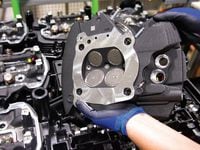
Sure, the cylinder head’s intake ports are altered to “provide optimum flow characteristics.” The spray angle of the sub-throttle injectors increased from 15 to 20 degrees to spread atomized fuel over a wider area, and a much larger exhaust header collector and tweaks to the muffler cans have all contributed in some degree to improving performance. But I suspect the mention made—almost in passing—of the bike’s ECU having been reprogrammed would account for the single largest contribution to the big Ninja’s improved street manners.

The old bike already made over 170 peak horsepower on our rear-wheel dyno and Kawasaki is only claming an additional 3 peak ponies at the crank on the new machine. Where the old bike suffered was its artificially hobbled power and response at lower rpm in the bottom four gears. My quick seat-of-the-pants street impression seems to indicate this is no longer an issue, or at least not nearly as noticeable.

Launching the bike down the dragstrip demonstrated the strength of its low-rpm torque. Kawasaki factory racer Rickey Gadson was on hand offering instruction on how to maximize the bike’s potential on the track. Following Gadson’s advice saw testers leaving the line at 3500 rpm aboard the standard-ride-height ZX-14 and upwards of 4500 rpm if the bike had been lowered with rear suspension dog-bones and fork tie-down straps.

My personal best run on the stock-height setup was a 10.035 @ 141.74 mph with a 1.74-second 60-foot time. I managed a 9.855 @ 141.33 pass on the lowered bike before a headwind picked up and slowed the proceedings. Earlier that week at a different location in the high desert, I’d posted a tailwind-assisted 9.70 second run (corrected to sea-level) on our stock-height 2008 Hayabusa testbike.

Only a same-day, same conditions head-to-head shootout between the 2008 ’Busa and this new Ninja will settle the score. Stay tuned!

Sound Off!  Who will be the champ?

– Kevin Cameron


BLAST FROM THE PAST


Blast

Now that new rules have restored four-stroke domination in racing classes from MotoGP to 250 MX, one can lose sight of the previous 25 years of two-stroke dominance. I saw it happen. At Marlboro, Maryland, I saw exotic two-strokes that included a water-cooled Adler Twin, various Bultacos and fragile TD1-A Yamahas go fast for five laps, then seize, allowing hammering Aermacchi or Ducati Singles to win. Yamaha adopted the practice of producing last year’s factory technology as this year’s over-the-counter production racer, but at first no one thought this was cool.

Blast
One of the “four-stroke-forever types” was AFM and ACA racer Ralph LeClerq, sponsored by Cycle World magazine in the 1960s. Here LeClerq’s 250cc Ducati Mark III is prepped for quarter-mile testing at Riverside Raceway in 1966.

Cool was having machine shops machine your four-stroke Single so that everything in it ran on needle bearings. Was this the secret of super-performance, or was it a momentary madness? Using just the bare framework of Dr. Schnuerle’s 1930s DKW concept—two dinky transfer ports, a single exhaust and a piston-controlled inlet port—Yamaha was able to make its 1965 TD1-B fast enough to leave the four-strokes behind. When two years later that company added much-needed reliability to the1967 TD1-C, the four-strokes were doomed no matter how many needle bearings whirled within them. Even Charlie Ingram, long the clever fox of Ontario’s Mosport circuit, had to abandon the game. Occasionally, on a short circuit, a pro-level Aermacchi (sold as a Harley) would retain its clattering pushrods and win the day.

Frank Camillieri and Andres Lascoutx, our Boston Yamaha aces, made it a practice to pass any four strokes they encountered sitting up, pretending to adjust their goggles. Those Yamahas, which look so spindly and primitive today, were considered coarse and unfair locomotives, winning races on sheer speed, acceleration and braking—not by means of the much more desirable Eurocentric finesse. Or needle bearings, installed without regard for expense.

By 1969 the only 250 Thumpers still evident in U.S. racing belonged to clubmen or die-hard four-strokes-forever types, and they had become a paddock nuisance. Nothing had mufflers in those days, and we had learned that warming-up two-strokes was best done at the paddock fence, with pipes pointed away from the people. Such courtesy was uncommon among the remaining four-stroke folks—maybe noise was their last territory.

Why should it be that riders of uncompetitive machines tended to be “throttle tuners”—starting their bikes in the pits, then revving them endlessly up and down on the centerstand, fiddling with adjustments? There was one of these next to us at Daytona in my first-ever trip to the place—1969—and his single long-taper megaphone was pointed straight at us. He was merciless. We were not only painfully blasted by noise but also peppered by the legendary “Ducati air balls”—what was left of blow-down pulses by the time they left the pipe. The owner’s problems were evidently severe—and so was the revving, flatching and banging. Unable to make myself heard over this wall of noise, I walked to the machine and covered the end of the meg with my shoe. Alarmed by the sudden change in exhaust note, the owner worked the throttle harder yet, only to have the engine die of constipation.

Only then did he look up from his task. Seeing us all glaring at him, and me with my foot in his pipe, he realized what was up.

“Oh. Uh...sorry.”

Sound Off!  Will you miss the two-stroke smoke?

– Kevin Cameron


ORANGES, CALAMARI AND THE VALENCIA MOTOGP


Wheeler

The Circuit de la Comunitat Valenciana Ricardo Tormo is situated just outside of Valencia, Spain, and a few miles from the famous town of Bunol, known for its once-a-year event where inhabitants board up the town and throw truckloads of tomatoes at each other. For the visitor, the surrounding scenery is not unlike the drive through the former U.S. Army base at Ford Ord on the way to Laguna Seca. It’s a dry, scrubby landscape with a similarly blue sky and a hint of citrus emanating from the masses of orange groves that line the valley. The weather is perfect.

Race weekend arrives. My wife and I pick up our credentials, parking pass and we’re set. After dropping off gear it’s time to get to work. It’s obvious by the look on many of the crewmembers’ faces that they’re glad this is the last race of the year. Even my fellow photographers are beginning to show hints that they’re ready to hibernate for a few months before it all cranks up again.

Amazingly, the crowds turn up early, the traffic flow into the track is handled perfectly, the crowds (a total of 130,000 people in all) fill the amphitheater-like stadium and there’s the Euro-typical sound of air horns, the waving of flags and fireworks going off all around me.

There are things that will remain with me from this weekend, like the fans standing and clapping each time Dani Pedrosa (who would go on to win the race), Nicky Hayden and the other “big boys” came around. Best of all was witnessing the end of season round up with the three champions perched upon their motorcycles whilst I sat on the warm race track waiting to get their picture and finally, enjoying one of the best racetrack food stalls I have ever visited on the planet.

Racing is all done for 2007. Roll on 2008.

– Andrew Wheeler, automotophoto.com


CHURCH OF EICMA


 Vicki

If you’re a person whose blood is classed not by type but by viscosity, the Milan EICMA motorcycle and bicycle show is where you come to pray. The massive show hosts 10 buildings of motorcycle displays with an emphasis on flair, whimsy and cutting-edge Italian style. This spectacle was a biannual affair until two years ago, when the council that organizes it secured a state-of-the-art location at the massive new 3.5-million-square-foot Fierra Milano exhibition center and declared itself the Mother Of All Motorcycle Shows.

Although I am a veteran Italian tourist—having competed in seven Motogiro d’Italias—as well as a long-time collector of Italian motorcycles, I still find EICMA exotic. A feast of sights and sounds, it’s historically where new product is introduced by Italian manufacturers like Ducati, MV Agusta and Bimota, a tradition of unveilings that goes back to the 1950s. This year was no exception and in a nod to the growing importance of this show, all the major players got in the game with a record 28 introductions. BMW topped the list with four models unveiled.

You never know what you are going to see at EICMA—supermodels on scooters, booming tecno music and fantastic displays that are small cities to themselves, side by side with niche makers of boutique titanium parts, purple tires and monkey bikes. I rounded corners with no idea what reaction I’d have; anything from a fully stirred soul to laughing out loud was possible. It’s a spectacle of the highest order best shared in photos with like minds.

Join me now for an insider’s view of a visit to EICMA 2007.

Vicki
That was no typo: the Fiero Milano center has 3.5 million square feet of indoor exhibit space. That’s 60 football fields (with end zones).

– Vicki Smith


STUCK IN THE SEVENTIES


Cool CB

There were 70-odd bikes for sale at the recent Von Dutch auction—none of them as sano as this piece parked outside the bidding tent. Yep, the coolest bike at the auction wasn’t even for sale!

An early-Seventies Honda CB750 Four, obviously, but literally swimming in period modifications (see photo gallery). An original custom, well cared for? A re-restoration? A brand-new build inspired by café/dragbikes back in the day? A Von Dutch connection?

Can’t say. After snapping the pix, I went off in search of the owner. No dice, and nobody seemed to know who the bike belonged to. When I returned to leave a business card on the seat, it was gone.

Dude, here’s hoping you or a friend browses the CW site. Get in touch. We want to put your bike in the magazine.

Sound Off!  What was your sportin’ ’70s ride?

– David Edwards


BMW’s SPIN CONTROL


BMW

So along comes an electronic BMW press release, usually delete fodder after a quick scan, but this one got my attention. Seems I’ve been unwittingly adding to a fallacy. Now, I’m almost never wrong…honest, just ask me. But for years I’ve been telling people that the famed BMW logo, the blue-and-white “roundel,” was borrowed from the company’s aircraft-engine division, an interpretation of a spinning propeller.

BMW
Basic structure of the roundel has remained the same since 1917 but there have been changes to color and type font, and a flirtation with the Motorsport version (lower left) in the early 1970s and ’80s.

BMW
Round and round: BMW ad for its airplane engines shows how confusion over the roundel’s imagery got started.

Apparently not.

In celebrating 90 years of the roundel, BMW sets the record straight: “It was on October 5, 1917, that the BMW trademark was registered…the inner circle featured quadrants in the Bavarian Free State colors of blue and white but in opposed order, as it was illegal to use national symbols in a commercial trademark.”

Duh! I’ve spent many a happy mile touring through Germany and Austria, and sure enough, almost every little Bavarian burg has blue-and-white checkered flags flying in the town center. Makes sense that a company called Bavarian Motor Works (Bayerische Motoren Werke) should show a little regional pride in its logo.

So where did the Great Spinning Propeller Myth come from? It seems BMW itself is partly to blame.

“The idea that blue and white had anything to do with spinning propellers comes from a 1929 advertisement that featured aircraft with the image of the roundel in the rotating propellers,” says the company. “This advertisement came at the beginning of the Great Depression, which coincided with BMW acquiring the license to build Pratt & Whitney radial aircraft engines. The advertising department used the roundel and BMW heritage in an attempt to increase sales of the new radial motors.”

Then another damn journalist got in on the act: “The idea of the spinning propellers was given greater credence in an article by Wilhelm Farrenkopf in a BMW journal of 1942. This also featured an image of an aircraft with a spinning roundel. These were powerful images and the legend of the spinning propeller was born.”

Normally, I’d take ol’ Wilhelm to task for his lack of fact-checking, but in this case I’m guilty, too. I hate when that happens...

– David Edwards


ROBERTS ROUNDUP


Roberts

Kenny Roberts is at a crossroads–again. The three-time 500cc world champion’s British-based effort has yet to firm-up plans for the 2008 season. What began as a dream tie-up with Honda has ended, the Japanese giant having supplied Roberts with engines in 2006 and ’07. Plans for a customer track-day bike powered by the CBR1000RR’s inline-Four were scrubbed. And talks with Ducati regarding the possible future use of engines or even complete bikes have so far been simply that–talks.

Roberts
In true Roberts style, Kurtis has maintained his sense of humor despite on-track struggles. He still dreams of winning a world title, just like his father and brother did.

Roberts
Kenny Roberts Jr. (foreground) sat alongside his father at the USGP at Mazda Raceway Laguna Seca. He hasn’t attended a race since.

This past October, at the Australian Grand Prix at Phillip Island, I spoke with team manager Chuck Aksland and rider Kurtis Roberts. The younger Roberts joined Team KR this past June in Italy, initially sharing riding duties with elder brother Kenny Jr. then taking over KR212V development in the 2000 500cc world champion’s absence. Aksland explained that a complete lack of engine updates during the season removed all hope of duplicating Kenny’s two podium finishes the previous year. Even cracking the top 10 proved impossible. “It’s been frustrating,” he lamented.

Roberts offered a broader view. “Motorcycle racing used to be a sport,” he said. “It was about guys competing on stuff they could win on. Now, whatever bike or tires are the best that weekend are going to win. It’s not like that in other sports. You can pick up a basketball and whoever has the talent is going to show through. Here, it’s gotten to the point where the bike and tires are so important, the sport has taken a step back.”

Aksland claimed that Roberts, a former AMA Supersport and Formula Xtreme champion, is riding “better than ever.” In Japan, he said, Kurtis’ corner speed matched that of Toni Elias’ Bridgestone-shod Gresini Honda RC212V. Yet the American’s qualifying run was nearly 3 seconds slower than that of the Spaniard. In Australia, Roberts slithered home dead-last on slide-prone Michelins. I watched post-race as team engineer Warren Willing described the lack of grip to a rep from the French tire-maker, who could only shrug his shoulders in response.

Last year, Dorna CEO Carmelo Ezpeleta told me that he would do “whatever is necessary” to keep Roberts in the MotoGP paddock. But with tumbling television ratings and the recent uproar over tires, Ezpeleta already has a full plate. Always optimistic, Aksland said sponsorship talks are moving along, and that the team should know something “soon.” Keep your fingers crossed.

–Matthew Miles


RIDING THE ICE AGE


Trek

If discomfort breeds memories, then my recent ride from Oakhurst to Huntington Lake, California, should last me a lifetime. Another take comes from Rush drummer Neil Peart in his recent book, Roadshow: “Adventures suck when you’re having them,” which I think he quoted from somebody else.

Trek
Sunshine shone after the snow had blown, and a spirited ride down the mountain to Big Creek for lunch was warm and pleasant. Despite this, the memory is still vivid.

In any case, I had loaded my ’58 Triumph Trophy into the back of my ’69 Ford F-250 and headed to Oakhurst, just south of Yosemite, the starting point of our annual invitation-only dual-sport industry ride called the Cycle World Trek. Normally, I’d go bashing in the woods on single-track trails with the other folks, but knee trouble put me on my Triumph and mostly asphalt and fire-roads. I peered out the motel window on the morning of our departure and saw pleasant skies and comfortably cool temperatures, so I went with jeans over long underwear, a wool sweater and my trusty waxed-cotton Belstaff jacket for the 120-mile tour up the mountain to 7000 feet. I picked up the insulated Moose enduro pants I’d packed just in case and thought “overkill,” then threw them in the chase truck.

Of course, it began snowing just a few miles into the ride, and by the time the lunch stop had filled with riders, the white stuff was piling up. There were trucks available for loading up but I thought, “This is the Triumph’s natural habitat and the colder it gets, it just keeps running better and better,” so I stuck it out. The remaining 100 miles was long and cold, with fear of ice on the road ever-present, but the bike did run magnificently. And if it weren’t for the shield of ice on my knees, shins and chest, I might have been really cold...

Sound Off!  What was your coldest ride ever?

–Mark Hoyer


THE BIG PUSH


Karma

Wonderful thing, good karma. You never know when it’s going to come in handy. Last Sunday, for instance.

A week or so before the big Hansen Dam Norton Club Ride, event organizer Bill “Bib” Bibbiani rings through, reminding me of the date, asking if I’d like to help judge the low-key concours after the ride, and wondering if Cycle World might be able to help sponsor the trophies as we’ve done in the past.

Karma
Object of deliverance: Homer Knapp’s Featherbed-framed Ariel special did double-duty at the SoCal Norton Club’s annual Britbike Ride.

I check the status of the Team CW slush fund and pledge a hundred dollars as usual.

Was gonna take my freshly done Triumph T140 Bonneville on the ride but its papers aren’t in order and the last thing I wanted to see was that blue beauty dangling from a wrecker’s hook on the way to some dank impound yard. Instead the Tiger 100 was rolled out. In the last stages of break-in following an engine rebuilt by my friend Stan Van Amburgh, the circa 1950s desert enduro bike was a good choice for another reason. It had been less than a month since the great Bud Ekins’ passing, and my Triumph wore a cocktail-shaker muffler and alloy front fender given to me by Ekins during a visit to his North Hollywood shop.

First part of the ride was wonderful, once we got past some insufferable wobblers on modern bikes apparently unaware that motorcycles negotiate corners...by leaning!!! The little 500 was sounding great and pulling strong as I let the revs wind out for the first time since the overhaul.

I was in loose formation with Mark Hoyer on his ’58 Triumph Trophy (given that the poor, long-suffering Velocette is still down) and Bill Getty, riding with the Missus on a 1954 Triumph T110 with odd semi-circular factory panniers that legend has it use fender blanks as lids. Also in tow, Allan Girdler on his star-spangled, apple-pie-on-wheels Harley XR-750 street-tracker, and Ken & Dustin Boyko, father and son—the Elder on a nice Triumph 650, the Younger aboard a Yamaha RD400.

Karma
American Flyer: Allan Girdler’s faithful XR-750 street-tracker has been together for almost 30 years. It’s due for a touch-up.

We got split up after lunch, so only AG was behind me when my Triumph suddenly became devoid of forward motion. Just then, Homer Knapp, trundled by on his Featherbed Ariel Square Four, hung a U-turn and idled up to investigate. Homer dug into his omnipresent toolbag, poked around the T100’s BTH magneto and pronounced it duff.

I was about to hand Allan the keys to my pickup and find some shade to await his return when Homer announced, “I’ll push ya.”

“It’s gotta be at least 20 miles back to Hansen Dam,” I reasoned.

“Yeah, well a lot of it’s downhill. Besides, I’m going that way anyway...”

Off we went, inches apart, Homer sticking his right leg out, pushing on my left footpeg, that tractor of an Ariel urging a combined 1000 pounds uphill. We took advantage of gravity when we could, and as I’d coast down to about 20 mph, Homer would pull alongside leg extended and get us back up to speed again. No serious bobbles and we only had to stop once for a red light the whole 20 miles.

We made it back to the starting point just as the awards ceremony was going off. Once Bib found out about Homer’s heroics, he presented Knapp with the event’s “Good Samaritan” award.

His prize? A hundred dollars...

Sound Off!  Got a favorite classic-bike event? Let the rest of us in on it!

–David Edwards

Related Reading
Vision Concept IN THE CLUTCH


MUSEUM TOUR


Museum Tour

Welcome to the Kevin Cameron Museum of Personal Junk. Over to my right are two cabinets, packed with files on obsolete subjects such as two-stroke scavenging, carburetors, and forks and suspension from the eons before Öhlins existed. Dark Ages. Even my toolbox testifies silently.

A visitor might ask something like, “Whad’ja do with this quarter-inch Spintite?”

That’s a jet wrench for Mikuni VM carburetors, hot stuff around 1968. What are jets, you ask? They were our precision fuel-metering system, little non-adjustable faucets with their flow capacity stamped onto them in tiny numbers—220, 230. The jets are brass, a material traditionally associated with conservative organizations such as the Navy. It polishes well and resists corrosion. I have hundreds. They sit in these boxes, resting comfortably.

Museum
Any port in a storm? Seventies-era RD350 cylinders sit in repose after getting scribed, blued and ground into a flurry of chips by hand in KC’s personal museum of junque. Lead photo shows a crank-truing stand. The truth is never obsolete.

These are my two flexible shaft grinders, used for port shaping back before casting processes existed that could produce essentially perfect shapes. Those are carbide cutters in the little plastic drawers. This one with big spiral teeth eased the boredom of hacking out the obstructive lumps in the floors of Yamaha RD350 exhaust ports. The bigger the bite the tool takes, the more likely it is to suddenly jump out and wind itself tight in my T-shirt.

This exhibit pretends two-strokes are coming back next week. This bottle of scribing dye allows one to mark the shape of the gasket onto the base of the cylinder, so cylinder and crankcase shapes will match.

“Scribed marks? Hand-grinding? Whoa, you gotta be kidding—what are you, like, 100 years old? We throw the heads on our CNC, hit Enter, and then go home to dinner. When we walk in next morning, all the ports are perfect.

“These bent black bananas—are they exhaust pipes or something? What are they made of, anyway—tungsten? They are heavy.”

As a matter of fact, they are steel and I apologize that they are not hydroformed from titanium sheet and then welded in an argon-filled glove box. Actually they were welded right here on this table with this Smiths “Airline” gas torch.

“Hey, what’s this thing over here, some kind of stand or carrier for spare engines?”

No, that’s a Yamaha TD1-B chassis.

“A chassis? But it weighs a ton! And it looks like it’s made of gross old water pipe.”

It is. Please put that down—I don’t want to get into the magneto thing—there are no parts available. You’re quite right, no laptops, this bike was built with IBM’s 7094 computer, which required multiple trailer trucks to move it. Times change, okay? I’ve heard the lecture—now the computer is smaller than your thumbnail, under a microscope it looks like a city of millions, and it does your income tax in its spare time as you run up the straightaway.

“Are these skinny tires solid or something? Like what’s on a tricycle?”

No, it’s an illusion. Race rubber hardens with age. See the inflation valves? They are regular pneumatic tires. With inner tubes.

“You don’t say? Well, hey, thanks for the tour. Wow, wire-spoked wheels—I’d never have believed it. Wait’ll I tell the guys.”

Sound Off!  What’s some archaic technology in your garage?

–Kevin Cameron


KEEPING IT REAL


Wheeler
clubxl
Honda XL250: Ride of choice for the Energizer Bunny.
clubxl
Pismo Beach provides mellow backdrop for May’s XL250. Photo-friendly bike provides the art guy a great excuse for a photo series that could remain in progress for many years to come. Next stop? Northern California’s Lost Coast Road.

Back in May, Editor-in-Chief Edwards suggested a follow-up item on my 1972 Honda XL250 that appeared in the magazine as a “Staff Stuff” story and on this website as a blog, both of which generated a significant response from readers with strong feelings for this historic little wonder. Inspired by Mr. Edwards’ stable of pristine examples of motorcycle history scattered around the CW property, I’d been on the fence about restoring my own charmer to showroom condition. To most observers, though, a restoration made as much sense as a breast reduction for Paris Hilton, botox for Scarlet Johansen or liposuction for Iggy Pop!

But enough with the celebrity metaphors. We posted a blog to find out what you thought about restoration versus natural patina and requested photos of your own XLs for show-n-tell. These are some of the responses we got:

“Spend the money on another XL250,” suggested Nick Macaluso (a.k.a. Borax Karloff from our forums).

“It serves us well to keep bikes like yours as is. Especially here in the U.S.,” mused J. Bryan.

“The paint is of the era and covering it with flawless new paint somehow seems artificial,” offered traditionalist Chad Spargo.

“Any jackass can have a restored bike. It takes a real man to enjoy a bike that shows its miles,” stated C.E. (who requested we conceal his identity).

“I wish they would make them half as good now. Enduros need to make a comeback, so all enduro riders unite!” exclaimed swoogydew.

But my favorite response was from Richele Silva at Curve Communications: “We’d like to rent your XL for use in a Honda brochure. We’ll pick it up, return it in 24 hours and pay you $200,” Richele offered.

“Sounds good,” I responded, “but I’ve gotta warn you, she’s not perfect.”

“That’s fine,” she answered without hesitation. “We want it to look ridden.”

So, the nays have it and thanks for your responses. The XL will remain as is. Less than perfect, but well preserved for a 30something and apparently nice enough for some part-time modeling, too.

Sound Off!  What have you restored?

– Keith May


Copyright© 2010 Hachette Filipacchi Media, U.S., Inc.
Home | Site Map | Contact Us | Privacy Policy - Your Privacy Rights
Terms & Conditions | Newsletter | HFMUS Sweepstakes | How to Advertise | Subscriptions/Customer Service

Visit other Hachette Filipacchi sites:
Car and Driver | ELLE | ELLEgirl | Filipacchi Publishing
PointClickHome | Premiere | Road & Track | Woman's Day