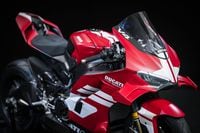
So, what exactly constitutes “character” in a motorcycle?
It’s an old debate and probably has as many answers as there are riders, but I’ll try to put in my two cents because Editor Hoyer has asked me to. He probably figured that, as a serial owner and restorer of British and Italian motorcycles—not to mention the occasional older Harley—I’d have strong opinions on the matter, much as someone who’s been hit by a train or run over by a steamroller harbors a few thoughts about orthopedic surgery. So, here goes.
First, I’ve always thought there’s a dangerous tendency to confuse character with unreliability, to assume that if a bike builds your own character, it must possess that same virtue. And, sadly, this often seems to be the case. I would say that the three most charismatic bikes I’ve ever owned were a Velocette Venom, a Vincent Black Shadow and a bevel-drive Ducati 900SS (all black with gold stripes, interestingly enough). In keeping with the old myth, the Velocette and Vincent were easily the two most unreliable bikes I’ve ever owned, requiring constant roadside fettling and repair. Yet the Ducati—though positively bristling with charisma and personality—never gave me one moment of trouble, no matter how hard I rode it.
Ditto for my later belt-drive Ducati 900SS and 996, bikes that were only an infinitesimally small notch below the 1970s Ducs in eccentric charm. I know all these models can have their problems, but mine never did. The same may be said for the two AMF-era Harley-Davidson XLCR Café Racers I’ve owned. This was supposed to be one of the worst eras ever for Harley quality control, yet both of my character-rich XLCRs were reliable as farm tractors—though marginally more sophisticated. You couldn’t kill ’em.
So, maybe we can dispense with unreliability being a prerequisite for character. But what about the irritation factor? Is a certain element of abrasiveness necessary to make an impression on our minds and relieve us of the boredom that comes from bland perfection? Maybe or maybe not. John Candy, in the film Planes, Trains and Automobiles, was an interesting and colorful character, but we’re not sure we’d want him around all the time. Same with General George Patton, I’m told. Abrasiveness seems to be part of the character formula, but it has to be parceled out sparingly.
For instance, those Ducatis I mentioned were trouble-free, but they did have their share of small anomalies in the convenience department—lack of steering lock, difficult valve adjustments, hard seats, “committed” riding positions, self-crashing sidestands, etc. You had to put yourself out a little bit to own them; they demanded something of the rider, and you had to meet them halfway to enjoy the benefits. Most bikes with character have a bit of that “not for everybody” warning built in.
BMWs are like this, too—especially the old airheads. These were reliable and charismatic bikes, but I used to wonder if BMW intentionally left a few irritants in their designs (unreachable sidestands, weird switchgear, marginal charging systems, etc.) just to give the owners something to forgive. Some rite-of-initiation hoop to jump through so that, like members of the Skull and Bones society, we might find ourselves among the anointed.
My Buell Ulysses has an element of this, as well, thanks to its Harley DNA. You put up with a lumpy idle and a noisy cooling fan for the rear cylinder, and in return you get a highly charismatic bike with remarkable torque, a hard-hitting exhaust note and a chassis of great technical sophistication. It’s not for everybody, but the fine balance of large virtue and small vice is just right for me.
And speaking of torque, you could probably do another whole essay on the relationship of torque to character. The only torque-free bike with real charisma I’ve ever owned was my Honda CB400F—and, to a lesser extent, my current CB550 Four. I suppose there are others, but I can’t think of them right now. Muscular corner-exit thrust makes up for many other shortcomings in a bike (see Norton and Hayabusa).
And so does beauty, which does seem to be one of the requirements for a bike with character, even if it’s brutal (Black Lightning) or utilitarian (R1200GS) beauty. And it has to be more than skin deep, as in beautifully machined, high-quality components made of metal. Nothing ruins a motorcycle’s chances of getting into the Character Hall of Fame like stamped-out components and badly chromed tin or plastic.
Okay, a few bikes, like the Yamaha RD350 or Kawasaki Mach III, are able to get around this dictum with scintillating performance and brilliant engineering, but not many. And both those bikes, in my humble opinion, are still quite good-looking. A prime requirement. The Ducati Indiana is probably almost as mechanically charismatic as my old 900SS, but there are only about five people on Earth who care. We tend to forgive many sins for the sake of beauty (see Norton again) but have a hard time discovering virtue in the midst of ugliness.
What else goes into the formula? Well, mechanical connectedness, I think. The bike has to send you strong, identifiable signals through the suspension and throttle. And then there’s the tradition and personal philosophy behind the design. We like to think that real people with definite ideas designed and built our bikes, preferably racing people with a sense of continuity (see GSX-R). No committees, no “The market demands a bike like this, therefore, we will make it.”
For some of us, I think nationality is part of the equation, as well. We like to reward cultures whose history, aesthetic sense and national character appeal to us in some personal way. Anglophilia probably sold more British bikes over the years (to me, at least) than did the irresistible lure of Lucas electrics.
And then there’s sound. The glorious magic of the right exhaust note…
Let me go get another ream of paper. I feel an essay coming on.